
Checking a company credit score is often treated as a quick lookup. In practice, it is a verification process that requires context, comparison, and judgment. Business credit scores are designed to answer different risk questions, depending on who is using them and why.
This guide focuses on how to check company credit scores methodically to verify data and understand how different scores fit together when you’re evaluating risk.
What Does It Mean to Check a Company Credit Score?
A company credit check with Experian, Equifax, or D&B means validating how a business is likely to behave financially under specific conditions, such as repayment, trade terms, or long-term obligations.
Unlike personal credit, where you get a single score, there are different models and ways to look at the data. So, scores depend on which credit bureau you use, and which metrics make the most sense. Together, they form a more comprehensive picture for verification.
Step 1: Verify the Correct Business Entity
Before you check a company’s credit score, you’ve got to make sure you’ve got the right business. This means its legal name, which may be different from brands or trade names. So, your first step is to verify the company’s legal name.
Mismatches are a common reason why you get incomplete or incorrect credit data. There are a lot of similar business names out there, and corporate restructures or even address changes can all impact how the data is gathered and reported.
Step 2: Understand Which Credit Score You Are Verifying
Business credit agencies measure risk differently. Some scores focus on the probability of late payment or default. Others emphasize trade payment timing or supplier-reported behavior. A score that is acceptable in one context may be insufficient in another, depending on whether the decision involves lending, trade credit, or vendor approval. Here’s how the major agencies compare.
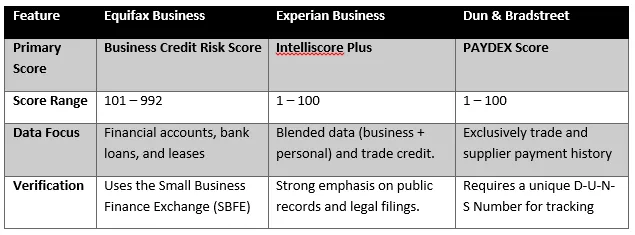
Step 3: Compare Credit Scores Across Business Credit Agencies
Verification improves when scores are reviewed side by side. While you can get an overall sense of a company’s financial health from any of the credit bureaus, comparing multiple business credit agencies provides a more comprehensive view.
Each credit bureau uses its own data sources, so there are often differences between them. These aren’t errors, but the result of valuing different data. Cross-checking scores allow you to look for variations and additional risk signals.
Step 4: Review Supporting Credit Data, Not Just the Score
A business credit score gives you an overall summary, but it doesn’t explain it. When you do a company credit check with Experian, Equifax, or D&B, you need to look at the data. Payment patterns, adverse records, and recent activity changes often provide more insight than the score itself. A stable score supported by consistent payment behavior is very different from the same score that also shows some negatives.
Trends are particularly important. When you see a deteriorating credit score, especially in a short period, it might indicate financial trouble on the horizon.
Step 5: Interpret Scores Based on the Decision You Are Making
There is no universal passing score for business credit. While the credit bureaus will classify risk as low, moderate, or high, your risk tolerance is specific to your organization. In general, trade credit decisions often prioritize payment behavior and trends. Lending decisions may weigh default risk more heavily, while evaluating suppliers or partners may focus on stability and the absence of adverse records.
Bottom line? You need to align the score with the specific risk you are trying to manage and how much risk you’re willing to take.
Verifying Company Credit Scores Through Command Credit
Command Credit makes it easy to pull business credit reports on demand from Experian, Equifax, and Dun & Bradstreet. You get access to all of the data you need, but without having to sign up for a long-term subscription or commit to a certain number of reports. You pay only for the reports you need and can access them instantly.
Check company credit scores instantly without a long-term commitment and make better, more strategic credit decisions.